I love symbols. As someone who majored in English, metaphors, similes, figurative language and symbols all hold a dear spot in my heart. Even better than symbols are patterns of symbols. In literature we can call these motifs.
Part of why I love Easter is the symbols. Rabbits, eggs, springtime – these are all symbols of a new season and new birth for plants and flowers. The name, “Easter” did not always refer to the Christian celebration. It is named after the Germanic goddess of springtime, Eostre.

Christianity then came along and grafted itself onto the name of this celebration, and eventually took it entirely over.
It seems so fitting to me that the Christian celebration of Jesus’ resurrection from the dead grew from a springtime celebration, and I love that we continue to use springtime motifs in our celebration of Easter. Easter is all about rebirth – of the seasons, of Jesus and of our previous lives into a life where we can know God.
What excites my literary mind even more than this, is that God has written this motif of rebirth into the very fabric of our world.
Jesus’ death and resurrection coincided with the Jewish festival, Passover. Passover celebrates the liberation of Israel (the group of people we now know as Jews) from being slaves in Egypt. Liberation too is a sort of rebirth. The pattern is weaved into the bible.

In the beginning, the Bible tells us, “it was good.” After this, death came into the world through sin and things got a lot worse. But we are promised in the book of Revelation a new heavens and earth, where there is “no more death or mourning or crying or pain, for the old order of things has passed away.” (NIV)
The Old Testament describes how one day out of every seven days, God’s people were to take a day of rest. Jews call this Shabbat and Christians call it Sabbath. The word means to cease, or stop, which in some ways is like a sort of death. The Torah (or Old Testament in Christianity) also mandated a Sabbath year called Shmita where all agricultural activity ceased. What is important to note here, is that although there are some similarities, Sabbath and Shmita are not times of death – Sabbath is a time of rest, rejuvenation and clinging to God, and Shmita allows the land to rest and recover. Rest was always intended by God – death was not. But perhaps this is a foreshadowing, suggesting that death, the death brought on by the fall, does not have to be final. The process of death can be used by God for growth and ultimately rebirth, just as God uses rest to renew us.
This pattern of motif that God has written into our world transcends just the Bible. We see it all throughout nature. As previously mentioned, we see it in the seasons, moving from birth in Spring to death in Winter, and back into the rebirth of spring. We see it every day when the sun rises. This Easter I have drawn a picture of the sun rising, which you can see below, to make up for the fact springtime imagery doesn’t work as well in the southern hemisphere!

We see it in baby teeth that must fall out to become adult teeth. We see it in caterpillars, who enter a cocoon and turn into butterflies. What comes after rebirth is often better than what existed before.

Another place we see the life, death, rebirth cycle is in the pains of childbirth. This reminds me of God’s punishment for original sin when he says,
“I will make your pains in childbearing very severe; with painful labor you will give birth to children” (NIV).
Death, both metaphorical and literal was a result of our sin. But God uses death for good, writing rebirth into the story.
Another beautiful way that God connects up this metaphor is in Romans 8:22:
“We know that the whole creation has been groaning as in the pains of childbirth right up to the present time.”
The birth that results from these groans is our “adoption to sonship.” The pains of childbirth are metaphorical for the pain of waiting for Christ to come and be reborn and enter into relationship with us.
And finally, we also see this pattern in our own minds. Claes Janssen developed a theory called the “Four Rooms of Change” which describes the ways in which people and organisations make transitions. The theory suggests that we start in a place of contentment, before moving into self-censorship and denial, then into confusion and conflict, and finally we arrive at inspiration and renewal. Can you see the pattern?
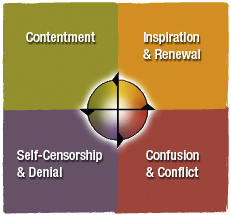
I think their observations rings true to our spiritual lives as well. We often go through times in faith when we feel a bit dead. I’ve heard this described as a “desert” before – a place where it feels like there is no growth. This might correspond to the second or third step in Janssen’s theory. This is definitely a place where I feel I have been recently. So much of Christianity feels painful and paradoxical at times. It is uncomfortable to grapple with elements of God that seem so conflicting. How can God contain both the servant king of Jesus, and the wrathful God of judgement? As William Blake asks, referring to God’s creation of the tiger, “did he who made the lamb make thee?”

At times I have certainly censored and denied these feelings. I still feel confusion and conflict. But I have hope! I know the story that God has written into the fabric of our world. And at times, I certainly do feel renewed and inspired to love God and others more fully. I trust that this time of spiritual conflict is a time that God is using to grow me, like a caterpillar in a cocoon or a fallen out tooth. I also know that this cycle will continue throughout my life – I will have many seasons of denial or confusion, but I also know what God has promised. James 1:2-4 says:
“Consider it pure joy, my brothers and sisters, whenever you face trials of many kinds, because you know that the testing of your faith produces perseverance. Let perseverance finish its work so that you may be mature and complete, not lacking anything.”
As I was trying to think of a way to end this article, my dear friend, Madi, brought the following quote to my attention. John Donne encapsulates perfectly the ultimate rebirth that will one day come.
One short sleep past, we wake eternally
And death shall be no more; Death, thou shalt die.
References
Origins of Easter: https://theconversation.com/why-easter-is-called-easter-and-other-little-known-facts-about-the-holiday-75025
Four Rooms of Change: http://www.fourroomsofchange.net.au/
General ideas including teeth analogy: https://podcasts.apple.com/au/podcast/inhabit/id1456064845
 arnot.art