“Friendship is unnecessary, like philosophy, like art, like the universe itself (for God did not need to create). It has no survival value; rather it is one of those things which give value to survival.”
— C. S. Lewis.
Hello dear friends,
My name is Brooklyn
I am creating this blog because I think art and literature and philosophy are immeasurably important. As an english tutor, I hear a lot of people talking about why books don’t really matter. Just like C. S. Lewis says above, they don’t really seem to have any practical value.
But, my goodness, they are so valuable! Most importantly, books and art and philosophy teach us critical thought and empathy. These things are not superfluous – rather, they are building blocks of a good society.
There is a story which I have noticed repeats itself again and again and again in literature. It goes like this:
There is a society which is being manipulated and controlled by an evil institution. This institution instils fear into the society so that its people will conform. The people in this society tend to be sheep, blind to what’s going on, or too scared to speak up. However, there is one person, often the protagonist, who challenges this power, sometimes triumphing, but usually dismally failing. If this sounds familiar, books and movies which reflect this plot include; The Crucible, The Handmaid’s Tale, Brave New World, 1984, A Clockwork Orange, The Village and The Truman Show. This story, despite being set in some distant world, is always a reflection of our own, and I believe that if more people understand this story, and the importance of critical thought, our world will be a better place. Critical thought is integral in a democratic society. It allows us to question what our government and corporations are doing, and challenge them. It allows us to notice when we are blindly conforming, when we are being tribalistic and when there is injustice.
The second thing art and literature give us is empathy – the ability to understand and relate to those who are different to us. I think empathy has the power to break down the barriers that divide our society. It can shatter tribalism and allow us to show kindness to the marginalised and vulnerable. I became convinced of this when I watched J. K. Rowling’s Harvard commencement speech titled, “The Fringe Benefits of Failure, and the Importance of Imagination.” I highly recommend it.
Finally, as a Christian, I think love (particularly, the radical, enemy-loving love of Jesus) is the only thing that can make our society a better place. So part of this blog is also going to discuss how literature, philosophy and art interact with my Faith. This blog will be a journey for me, and will show the unravelling and weaving together of my thoughts. Part of my reason for making this blog is to understand and explain (partly to myself) the conviction that literature can improve our society. Since I have the same conviction about Christianity, I’m inevitably going to be discussing them together.
On that note, I invite you to take this journey with me!
His drive for revenge? His lack of empathy? His hatred of Antonio? I think Shakespeare actually poured a lot of himself into Prospero. Prospero’s fatal flaw, much like Shakespeare’s, is that he is a playwright. He is obsessed by the humanities.
Prospero tells Miranda that his obsession with books was precisely what stopped him from noticing that his brother, Antonio, was plotting to overthrow him.
And Prospero the prime duke, being so reputed
In dignity, and for the liberal arts
Without a parallel; those being all my study,
The government I cast upon my brother
And to my state grew stranger, being transported
And rapt in secret studies.
The Tempest, Act 1, Scene 2
He was so obsessed with reading that he didn’t get out and run his country. I think that’s a pretty relatable flaw, but I’ll get back to that.
During the play, Prospero’s desire for revenge is secondary to his desire to orchestrate. He directs the action on the island, writing a story of hatred, revenge, forgiveness and romantic love. In order to achieve this he uses magic, which he learns through his “books.” It seems to me like this magic is just a metaphor for the theatrical magic of words, created by Shakespeare himself.
When I studied the Tempest at school, I wrote an essay arguing how Prospero overcomes his fatal flaw of revenge through forgiveness. However, after years of reflecting on the play, I’ve come to a different conclusion. I think forgiving Antonio and freeing Caliban and Arial was part of his plan all along – it was part of the play he was directing and the story he was writing. Prospero never overcomes his fatal flaw. Perhaps he physically drowns his book by the end, but his obsession has gotten worse – now he’s writing the book.
I think this reading makes much more sense. While studying the text at school, I was always perplexed by why Prospero suddenly turned around and forgave everyone. There was no arc, no gradual discovery, He just went from evil to benevolent in a matter of seconds, based on a single comment by Ariel.
The problem is Prospero’s transformation never seemed very human to People don’t usually turn from bloodthirsty revenge to forgiveness when someone says, “if you saw these people, you’d feel sorry for them.” In fact the normal human response is “Excellent, my plan is working!” One of the reasons Shakespeare is such an utterly brilliant playwright, is he expresses the human condition throughout his work. He shows people as they are. I am not convinced We see a real human in Prospero’s unexpected moral transformation.
If Prospero didn’t really, genuinely, authentically forgive his brother and the shipwrecked Venetians, then perhaps the play doesn’t have a happy ending. Prospero never overcame his fatal flaws of revenge and obsession with books and power, they overcame him. His forgiveness is not altruistic, but part of his plot to recover his Dukedom and marry off his daughter to a wealthy prince.
Just before I wrote this I was sitting at a cafe bookstore, thinking, “I would love to come here everyday and spend all day reading books.” But another thought keeps nagging at me, “maybe reading all day is dangerous, perhaps there can be sinister consequences for living life entirely in books.”
For somebody like me who thinks reading and education are integral to creating good people and a good society, there is a risk of becoming too absorbed with the intellectual. Reading should incite our action; our love for others, our love for the environment and our love for God. Reading should make us go out and help the needy, the marginalised and oppressed in our society and world. As James says:
22 Do not merely listen to the word, and so deceive yourselves. Do what it says. 23 Anyone who listens to the word but does not do what it says is like someone who looks at his face in a mirror 24 and, after looking at himself, goes away and immediately forgets what he looks like.
James 1:22-24 (NIV)
So perhaps that is why I am creating this blog (what blog? I am writing this on a note on my Mac with some vague idea that this idea could start a blog). Because I truly believe literature is important, but I don’t want it to become a means of indulgence for me. I want to keep focusing on how literature can help us improve as individuals. I also want to keep myself accountable to only looking at literature where it is useful, and using it as a springboard for the truly important stuff: helping people, giving voices to the oppressed and for me personally, showing the love of Jesus through the way I live.
I love symbols. As someone who majored in English, metaphors, similes, figurative language and symbols all hold a dear spot in my heart. Even better than symbols are patterns of symbols. In literature we can call these motifs.
Part of why I love Easter is the symbols. Rabbits, eggs, springtime – these are all symbols of a new season and new birth for plants and flowers. The name, “Easter” did not always refer to the Christian celebration. It is named after the Germanic goddess of springtime, Eostre.
Christianity then came along and grafted itself onto the name of this celebration, and eventually took it entirely over.
It seems so fitting to me that the Christian celebration of Jesus’ resurrection from the dead grew from a springtime celebration, and I love that we continue to use springtime motifs in our celebration of Easter. Easter is all about rebirth – of the seasons, of Jesus and of our previous lives into a life where we can know God.
What excites my literary mind even more than this, is that God has written this motif of rebirth into the very fabric of our world.
Jesus’ death and resurrection coincided with the Jewish festival, Passover. Passover celebrates the liberation of Israel (the group of people we now know as Jews) from being slaves in Egypt. Liberation too is a sort of rebirth. The pattern is weaved into the bible.
In the beginning, the Bible tells us, “it was good.” After this, death came into the world through sin and things got a lot worse. But we are promised in the book of Revelation a new heavens and earth, where there is “no more death or mourning or crying or pain, for the old order of things has passed away.” (NIV)
The Old Testament describes how one day out of every seven days, God’s people were to take a day of rest. Jews call this Shabbat and Christians call it Sabbath. The word means to cease, or stop, which in some ways is like a sort of death. The Torah (or Old Testament in Christianity) also mandated a Sabbath year called Shmita where all agricultural activity ceased. What is important to note here, is that although there are some similarities, Sabbath and Shmita are not times of death – Sabbath is a time of rest, rejuvenation and clinging to God, and Shmita allows the land to rest and recover. Rest was always intended by God – death was not. But perhaps this is a foreshadowing, suggesting that death, the death brought on by the fall, does not have to be final. The process of death can be used by God for growth and ultimately rebirth, just as God uses rest to renew us.
This pattern of motif that God has written into our world transcends just the Bible. We see it all throughout nature. As previously mentioned, we see it in the seasons, moving from birth in Spring to death in Winter, and back into the rebirth of spring. We see it every day when the sun rises. This Easter I have drawn a picture of the sun rising, which you can see below, to make up for the fact springtime imagery doesn’t work as well in the southern hemisphere!
We see it in baby teeth that must fall out to become adult teeth. We see it in caterpillars, who enter a cocoon and turn into butterflies. What comes after rebirth is often better than what existed before.
Another place we see the life, death, rebirth cycle is in the pains of childbirth. This reminds me of God’s punishment for original sin when he says,
“I will make your pains in childbearing very severe; with painful labor you will give birth to children” (NIV).
Death, both metaphorical and literal was a result of our sin. But God uses death for good, writing rebirth into the story.
Another beautiful way that God connects up this metaphor is in Romans 8:22:
“We know that the whole creation has been groaning as in the pains of childbirth right up to the present time.”
The birth that results from these groans is our “adoption to sonship.” The pains of childbirth are metaphorical for the pain of waiting for Christ to come and be reborn and enter into relationship with us.
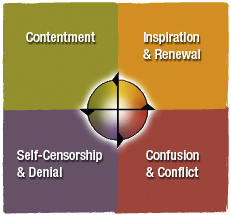
And finally, we also see this pattern in our own minds. Claes Janssen developed a theory called the “Four Rooms of Change” which describes the ways in which people and organisations make transitions. The theory suggests that we start in a place of contentment, before moving into self-censorship and denial, then into confusion and conflict, and finally we arrive at inspiration and renewal. Can you see the pattern?
I think their observations rings true to our spiritual lives as well. We often go through times in faith when we feel a bit dead. I’ve heard this described as a “desert” before – a place where it feels like there is no growth. This might correspond to the second or third step in Janssen’s theory. This is definitely a place where I feel I have been recently. So much of Christianity feels painful and paradoxical at times. It is uncomfortable to grapple with elements of God that seem so conflicting. How can God contain both the servant king of Jesus, and the wrathful God of judgement? As William Blake asks, referring to God’s creation of the tiger, “did he who made the lamb make thee?”
At times I have certainly censored and denied these feelings. I still feel confusion and conflict. But I have hope! I know the story that God has written into the fabric of our world. And at times, I certainly do feel renewed and inspired to love God and others more fully. I trust that this time of spiritual conflict is a time that God is using to grow me, like a caterpillar in a cocoon or a fallen out tooth. I also know that this cycle will continue throughout my life – I will have many seasons of denial or confusion, but I also know what God has promised. James 1:2-4 says:
“Consider it pure joy, my brothers and sisters, whenever you face trials of many kinds, because you know that the testing of your faith produces perseverance.Let perseverance finish its work so that you may be mature and complete, not lacking anything.”
As I was trying to think of a way to end this article, my dear friend, Madi, brought the following quote to my attention. John Donne encapsulates perfectly the ultimate rebirth that will one day come.
One short sleep past, we wake eternally And death shall be no more; Death, thou shalt die.
I have read that Angela Carter herself described the novel as “a juicy, overblown, exploding Gothic lollipop.” This description seemed to me, at first, a tacky undervaluing of this beautifully woven world. Yet, on deeper thought, I think it is appropriate.
I devoured this book. I had been slowly reading Carter’s Nights at the Circus for months, and (although by no means a bad book) I felt no compulsion to continue reading. Three quarters way through, I lost the book and picked up Heroes and Villains. I started reading it at the doctor’s surgery and was overcome by the abundant pleasure of it. For the next week, opening its pages was like a secret, dirty treat. I was captivated, yet always anxious that I was enjoying some trashy, dystopian teen fiction. I’m still not really sure.
The story starts like a fable about a somewhat unlikeable girl. Carter dedicates much time to intricately weaving a world that has been destroyed so thoroughly by war that it appears as a distant, timeless past. Perhaps the most compelling element of this novel is the complexity of the characters. It seems to be a manifesto against the very idea of “heroes and villains,” portraying humans as messy, unlikeable, beautiful, passionate, violent and sick. These characters and this world are augmented by the confidence of Carter’s writing, describing them in all of their filthy details; the lice, the germs, the blood, the masturbation and the rape. The repulsion is addictive. The confidence even makes Carter’s prose seem clumsy at times, but this clumsiness only confirms the imperfectness of the world and the characters who inhabit it.
I loved this book, although, it is not an oyster in its class, or a crustless sandwich triangle in its perfection. This is a juicy, suckable, un-put-down-able lollipop.







 arnot.art